
UAE Gift Giving Etiquette: Essential Customs and What to Avoid
02 Sep 2026 · TNE Gifts
📑 Table of Contents
- What Is the Basic UAE Gift Giving Etiquette for a Home Visit?
- What Should You Not Give as a Gift in the UAE?
- What Is the Legal Position on Alcohol as a Gift in the UAE?
- How Do You Know a Food Gift Is Genuinely Halal?
- What Happens When You Are Invited to a Home or a Majlis?
- How Do You Handle the Arabic Coffee Ritual?
- Which Gift Types Are Always Safe in the UAE?
- What About Dates, Oud and Incense?
- Does the Occasion Change the UAE Gift Giving Etiquette?
- Frequently Asked Questions About UAE Gift Giving Etiquette
- Conclusion
An Emirati colleague invites you to his family home. The invitation is warm and casual. The panic that follows is neither.
Most guidance on this question is written by gift shops. Search for what not to bring and the same list appears everywhere: black wrapping paper, dog imagery, sharp objects, playing cards. None of those pages cite a single source.
This guide takes UAE gift giving etiquette claim by claim. Each one below is labelled by where it comes from: the legal position, documented custom published by UNESCO or the UAE government, or considerate practice, which means a judgement call rather than a rule. The section on claims that could not be substantiated is the one worth reading twice.
What Is the Basic UAE Gift Giving Etiquette for a Home Visit?
Bring something modest and shareable, offer it with the right hand, and expect the host to set it aside rather than open it. Warmth matters more than value.
Hospitality here is not a social nicety layered over daily life; it is formally documented as heritage. The UAE government lists hospitality among the country's defining features, naming "hospitality, tolerance, family cohesion and solidarity among members of the society". A guest arriving with a small gift is joining something the host already takes seriously.
Here is the short version, sorted by how well each point is actually established.
| Practice | Which tier | What to do |
|---|---|---|
| Offering and receiving with the right hand | Documented custom | Use the right hand, or both hands, when giving and accepting |
| Arabic coffee when it is served | Documented custom | Take at least one cup, and no more than three |
| Alcohol as a gift | Legal position | Depends on the emirate and the household, see below |
| Pork and non-halal ingredients | Considerate practice | Check the label, choose a certified product instead |
| Removing shoes at a majlis entrance | Considerate practice | Follow whatever the household is already doing |
| Black wrapping, dogs, sharp objects, playing cards | Could not be substantiated | Widely repeated online, no source found |
Right-hand giving comes up repeatedly in Emirati practice and is worth getting right, though it is a small mechanical habit rather than a test. For workplace gifting, which follows a different set of considerations entirely, the corporate gifting guide covers that ground.
What Should You Not Give as a Gift in the UAE?
Avoid pork products, non-halal food and anything intimate. Beyond that, most of the prohibitions circulating online have no traceable source and can be safely set aside.
There is a real difference between a gift that conflicts with religious practice and a gift that a retailer's blog decided was unlucky. Sorting the two makes the decision far easier.
Considerations with a genuine basis
Pork and pork derivatives. Not permissible in Islam, and it hides in less obvious places: gelatin in sweets, some glazes and emulsifiers. Reading the ingredients panel handles almost all of it.
Alcohol, including as an ingredient. Liqueur-filled chocolates are the common trap, sold openly and rarely flagged on gift packaging. The legal position is covered next.
Anything intimate or personal. Perfume, clothing and jewellery all carry an implied familiarity. Between colleagues or new neighbours, food and flowers avoid the question entirely.
Religious iconography from other faiths. Figurative statues and devotional objects sit awkwardly in a Muslim household. This is a judgement call about the recipient, not a prohibition.
Claims that could not be substantiated
Several widely repeated rules could not be traced to any government, UNESCO or standards source. Every page found asserting them was a gift retailer or a culture blog, and each appeared to be citing the others.
- Black wrapping paper is offensive. No source found.
- Dog imagery causes offence. Views on dogs in the home vary among households, but no published guidance treats a dog on a gift as a breach of etiquette.
- Sharp objects sever the relationship. This is a well-documented superstition in parts of East Asia. No UAE or Gulf source was found for it.
- Playing cards imply gambling and must be avoided. No source found.
- Buddha statues cause offence. This collapses into the broader point about religious iconography above, and does not need its own rule.
None of this means such a gift is a good idea. It means the confident tone these lists are written in is not earned. Anyone weighing up UAE gift giving etiquette deserves to know which constraints are real and which are simply repeated.
What Is the Legal Position on Alcohol as a Gift in the UAE?
Alcohol is legal in most emirates under licensing rules and illegal to drink or possess in Sharjah. Whether it suits the recipient is a separate question.
This is where the incumbent advice is not merely unsourced but wrong. A blanket "alcohol is forbidden in the UAE" is inaccurate for most of the country.
According to UK Foreign, Commonwealth and Development Office travel advice, "Drinking or possessing alcohol is illegal in the Emirate of Sharjah, 30km north of Dubai." The same guidance sets out the licensing position elsewhere: residents of Dubai who want to buy alcohol to drink at home need a liquor licence, and licences are no longer required for residents in the other emirates excluding Sharjah.
So the legal picture varies by emirate and the social picture varies by household. No government source supports the flat instruction that alcohol must never be given to a Muslim recipient. What can be said plainly: many observant households would not welcome it, and a gift that requires the recipient to explain themselves is a poor gift. If there is any doubt, the question answers itself.
How Do You Know a Food Gift Is Genuinely Halal?
Look for the Halal National Mark on the packaging. It is issued under a national framework rather than by the manufacturer, so the claim is verifiable.
The UAE operates a formal halal certification system through the Ministry of Industry and Advanced Technology. The Halal National Mark is issued by the Department of Conformity within the ministry, and the governing standard is UAE.S 2055 -1, "Halal products - Part one: General Requirements for Halal Food". Halal certification bodies are registered by the ministry and must comply with the approved standards set out in Cabinet Decree 10/2014.
In practice, for a gift, this means two habits:
- Look for the Halal National Mark rather than the word "halal" printed decoratively on a box. The mark points to an accredited process behind it.
- Read the ingredients for gelatin and for alcohol used as a flavouring, the two things most likely to appear in confectionery without any obvious signal on the front of the pack.
This is why chocolate, cakes, flowers and gourmet hampers dominate the safe list: sealed products let the recipient check for themselves, and flowers raise no dietary question at all.
What Happens When You Are Invited to a Home or a Majlis?
A majlis is the household's formal sitting and receiving space. Expect coffee and dates on arrival, unhurried conversation, and a host who treats the visit as an honour.
The majlis is inscribed on UNESCO's intangible cultural heritage lists. UNESCO describes a majlis as a sitting place where community members gather to "discuss local events and issues, exchange news, receive guests, socialize and be entertained", noting there is usually a stove or fire on hand for coffee, which is why it arrives so quickly.
The welcome itself is documented too. The UAE government's own account of Emirati food culture states that "Guests and visitors are traditionally welcomed with coffee and dates."
Two further points sit in the considerate practice tier rather than the sourced one. Many guests find shoes are left at the entrance to a majlis, so the safest approach is to follow what the household is already doing.
When greeting someone of the opposite gender, it is worth waiting for them to extend their hand first. Neither point is presented here as a documented rule, because no live official source could be found stating them.
If the invitation is from a neighbour who has recently moved in, the housewarming gift guide covers what travels well into a new home.
How Do You Handle the Arabic Coffee Ritual?
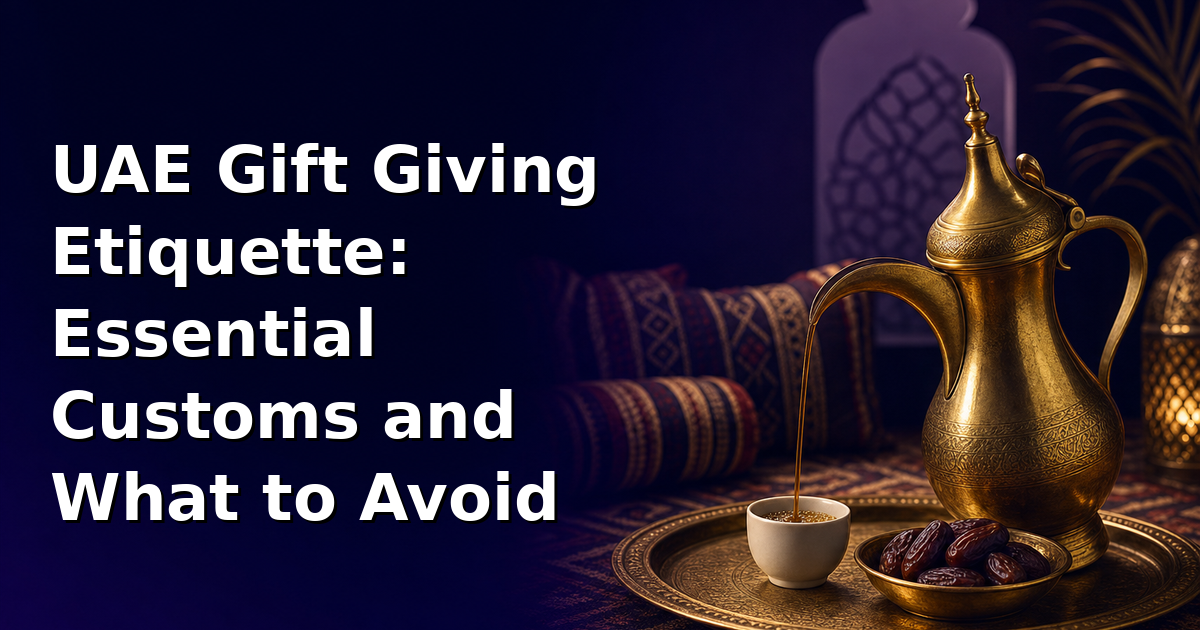
Accept the cup with your right hand, drink at least one and no more than three, then shake the cup gently from side to side to signal you have finished.
This is the moment most first-time guests get wrong, and it is the part almost no guide explains. Arabic coffee, or gahwa, is itself UNESCO-inscribed, and the mechanics are documented rather than folklore.

- The cup will look almost empty. Abu Dhabi Culture notes that the cup is only filled a quarter full. This is deliberate courtesy, not meanness, because it keeps the coffee hot and invites a refill.
- Hold the small handle-less cup, the finjan, in your right hand. Abu Dhabi Culture's guidance specifies the right hand, and spells the cup "finjal"; the spelling "finjan" is also widely used, including by the UAE government.
- Take at least one cup, and stop at three. Abu Dhabi Culture describes common practice as drinking "at least one cup but not exceed three". Refusing altogether reads as a rejection of the welcome; a single cup is perfectly polite.
- Elders and guests are served first. UNESCO's description of Arabic coffee records that older people and guests are served first, and that the coffee must be poured using the right hand.
- Shake the cup when you are done. This is the single most useful thing to know, and it is documented word for word. UNESCO states: "It is also customary for the person drinking the coffee to shake their cup to signal that they are done." A small side-to-side tilt is enough. Without it, the server will keep refilling.
Get this one sequence right and the rest of the visit tends to look after itself.
Which Gift Types Are Always Safe in the UAE?
Flowers, cakes, chocolate and gourmet hampers carry no dietary, religious or legal complication. They are shareable, they suit a household rather than an individual, and they are easy to verify.
The logic is simple: a gift the whole family can share fits the setting better than something personal.
Gourmet hampers arrive as an occasion in themselves. The White Elegance Gift Basket at AED 264 is a woven basket of gourmet snacks in reusable glass jars with Ferrero Rocher, the kind of gift kept long after the food is gone. More sit in the gourmet hampers collection.
Chocolate is the most reliable neutral choice. The Ferrero Rocher Bouquet Box at AED 213 arranges the chocolates in a black and gold presentation box beneath a bubble balloon carrying a message you choose, so you set the tone yourself.
Flowers raise no dietary question at all. For a household rather than a romantic gesture, mixed colours read better than red roses: the TNE Brilliant Roses Bouquet at AED 624 runs to roughly 80 to 100 roses across red, yellow, orange, pink, peach and ivory. The bouquet range and the broader gift combinations cover lighter price points.
Most TNE Gifts combinations let the sender choose the message, which matters more than the gift itself when a relationship is new. Orders are confirmed with a delivery photo, and the WhatsApp concierge can check details before anything is sent, across all seven emirates in three standard delivery windows. For a gift thanking a host afterwards, the thank you gift guide is the natural next step.
What About Dates, Oud and Incense?
Dates and oud are the most culturally resonant gifts in the Gulf. TNE Gifts stocks neither, so treat this section as context rather than a recommendation.
Dates are woven into the welcome itself, arriving alongside the coffee. The UAE government notes "More than 40 varieties of dates are grown in the UAE; each having its own distinct colour and flavour", which makes a box of dates genuinely local rather than generic. Premium retailers are easy to find in any major mall, Bateel among the best known, though Bateel is Saudi-founded rather than Emirati.
Oud is the serious end of Gulf gifting. Dubai's Al Shindagha Museum explains that oud comes from one of the rarest and most expensive woods in the world, from the bark of Aquilaria trees. That rarity cuts both ways: quality varies enormously, prices run high, and preference is personal. A confident choice for a close friend, a risky one for a colleague.
Bakhoor and the mabkhara are the incense chips and the burner used to scent a home. No authoritative published source describing their customary use could be found, so they are described here plainly rather than wrapped in claims about ritual.
For a first visit, the safer route is the shareable one: something from the gift combinations range that the household can enjoy together.
Does the Occasion Change the UAE Gift Giving Etiquette?
The core courtesies stay constant. What changes is timing and what is traditionally given, particularly around the two Eids.
Eid is the largest gifting moment of the year. The UAE government lists Eid Al Fitr as running from 1 to 3 Shawwal, with a fourth day depending on whether Ramadan runs a full 30 days, and Eid Al Adha from 10 to 12 Thu Al Hijjah. Because "Islamic holidays are determined according to moon sighting", the dates shift each year and confirm only shortly beforehand.
Traditional Eid gifting centres on Eidiya, sweets and clothing, with flowers a modern addition rather than a custom. The Eid gift guide covers it properly, and the small Muslim occasion range carries a couple of Eid-ready boxes.
For everything else across the calendar, from new homes to national celebrations, the UAE celebrations gifting guide maps the year.
Frequently Asked Questions About UAE Gift Giving Etiquette
Short answers to the questions that come up most often before a first visit to an Emirati or Muslim host's home.
What should you not gift in the UAE?
Pork products, non-halal food, alcohol-filled confectionery and intimate items such as perfume or clothing. Beyond those, popular claims about black wrapping paper, dog imagery, sharp objects and playing cards could not be traced to any government or UNESCO source, and appear to originate with gift retailers rather than documented custom.
Is it rude to refuse Arabic coffee?
Declining altogether can read as turning down the welcome itself, since coffee and dates are the traditional greeting. Accepting one cup is entirely sufficient. Abu Dhabi Culture describes common practice as at least one cup and no more than three, so a single cup sits comfortably within the convention.
Can you give alcohol as a gift in the UAE?
Legally it depends on the emirate. UK FCDO advice states that drinking or possessing alcohol is illegal in Sharjah, while residents elsewhere may buy it, with Dubai requiring a home liquor licence. Socially it depends entirely on the household, so for a first gift the safe categories avoid the question.
Should you open a gift in front of the person who gave it?
Often it is set aside and opened later, which is a courtesy rather than a slight. Do not read anything into it, and do not press the host to open yours. If you are the one receiving, either choice is fine; following the host's lead is simplest.
Is it acceptable to give money as a gift in the UAE?
Cash has a recognised place in the form of Eidiya, money given to children at Eid. Outside that context, cash between adults can feel transactional, particularly with a new colleague or neighbour. A shareable gift communicates the same generosity without the awkwardness.
Do you need to bring a gift when invited to an Emirati home?
It is not obligatory, and no host will hold its absence against you. Bringing something small is warmly received and is the easier position to be in. Sweets, chocolate, flowers or a gourmet basket all suit the setting because the household can share them.
How do you know if chocolate is halal in the UAE?
Look for the Halal National Mark, issued by the Department of Conformity at the Ministry of Industry and Advanced Technology under standard UAE.S 2055-1. Then check the ingredients for gelatin and for alcohol used as flavouring, the two things most likely to appear in confectionery without any front-of-pack indication.
Conclusion
Good UAE gift giving etiquette comes down to knowing which tier a claim sits in: law, documented custom, or retailers repeating each other.
A handful of things are legal matters, a handful are documented custom worth following closely, and a surprising amount of what circulates online is simply repetition. Bring something shareable, offer it with the right hand, take the coffee, and shake the cup when you are finished. That covers nearly every first visit.
When something needs to arrive properly, TNE Gifts delivers flowers, cakes, chocolate and gourmet hampers across all seven emirates with photo confirmation on delivery. Browse the gourmet hampers or the full gift range to send one.